
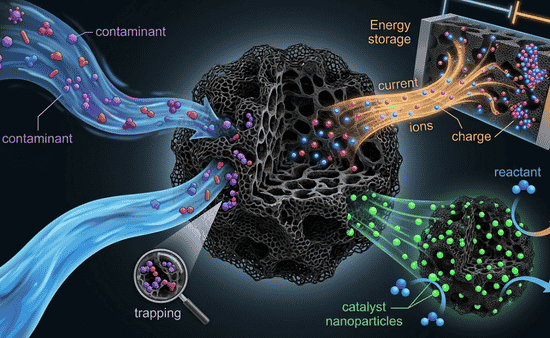
Modern materials are expected to do more than ever before. They need to be lighter, stronger, more efficient, more stable, and more adaptable across different applications. From energy storage to filtration, electronics, coatings, and environmental technologies, material performance often depends on what happens at the microscopic level. This is where high-surface-area carbon becomes especially important.
High-surface-area carbon is valuable because it provides more active space within a small amount of material. Instead of only offering an outer surface, it contains a network of tiny pores that increase the available area for reactions, adsorption, storage, or interaction with other substances. This makes materials like nanoporous carbon powder highly useful in advanced manufacturing, research, and industrial applications.
What High-Surface-Area Carbon Means
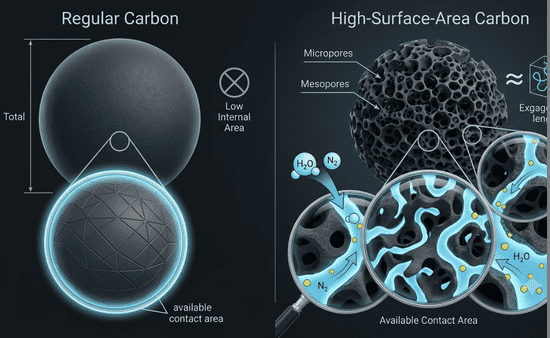
Surface area refers to the total area available for contact within a material. In regular solid materials, most of the usable surface is on the outside. In high-surface-area carbon, the internal pore structure creates far more available surface. These pores can be extremely small, allowing the material to interact with gases, liquids, ions, or molecules in a controlled and efficient way. The value of this structure comes from how much activity can happen inside a small volume.
A material with greater surface area can often hold more, react faster, or filter better than a material with a lower surface area. This is why porous carbon is often used when precision and efficiency matter. In many modern applications, performance is not only about the chemical makeup of the material. The shape, pore size, pore volume, and internal structure also play a major role. A well-designed carbon material can improve results without requiring a large amount of added material.
Why Pore Structure Matters
The pores inside high-surface-area carbon are one of its most important features. These pores can help control how molecules move, attach, separate, or react. Smaller pores may be useful for trapping certain molecules, while larger pores can help improve flow and accessibility. This makes carbon pore structure important in filtration, purification, catalysis, and energy storage materials. When the pores are designed properly, they can support better performance and more consistent results.
The material becomes more than just a filler or additive. It becomes an active part of how the final product functions. Pore structure also affects speed. If molecules can move through the material more easily, the system may respond faster. If the pore network is too limited, performance may slow down. This balance is one reason high-surface-area carbon is carefully studied and selected for advanced applications.
Supporting Better Filtration and Adsorption
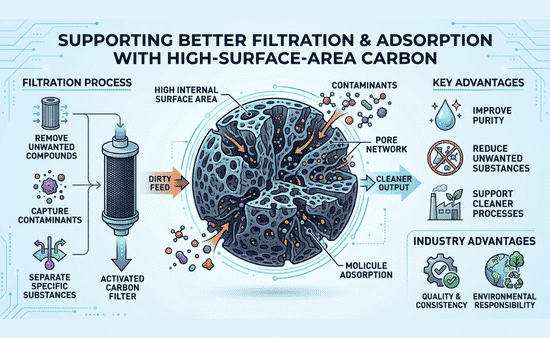
One of the most common reasons high-surface-area carbon matters is its ability to support adsorption. Adsorption happens when molecules attach to the surface of a material. Since high-surface-area carbon has so much internal surface, it can provide many sites for molecules to attach. This is useful in systems that need to remove unwanted compounds, capture contaminants, or separate specific substances.
Carbon-based materials are often valued in filtration because they can interact with a wide range of molecules. The internal pore network gives them the ability to capture materials that may not be easily removed through basic filtering methods. Efficient adsorption can help improve purity, reduce unwanted substances, and support cleaner processes. For industries focused on quality, consistency, and environmental responsibility, this type of material can provide an important advantage.
Helping Advance Energy Storage
High-surface-area carbon also plays an important role in energy storage. Devices that store and release energy often depend on fast movement of ions and strong contact between materials. A larger surface area can provide more active sites for these interactions. In applications such as supercapacitor materials and battery components, carbon can help improve conductivity, stability, and charge movement.
The pore structure can support faster ion access, while the carbon framework can help maintain durability under repeated use. As demand grows for better energy systems, materials that can improve storage performance are becoming more important. High-surface-area carbon can help support lighter, more efficient, and more reliable energy technologies. Its structure makes it useful for research and development in systems where both power and long-term stability matter.
Improving Catalysis and Chemical Processes
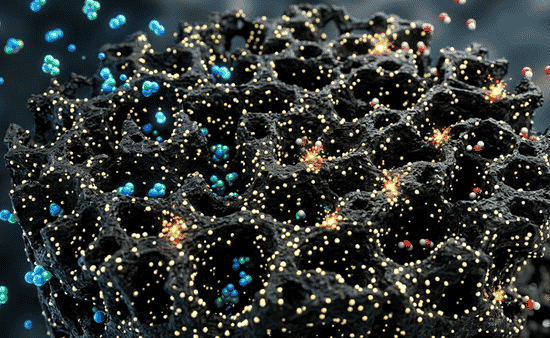
Catalysis is another area where high-surface-area carbon can be valuable. Catalysts help speed up chemical reactions, and they often need a strong support material to hold active particles in place. High-surface-area carbon can provide a stable platform with many contact points. This can help improve how well the catalyst performs. More surface area can allow better dispersion of active materials, which may improve reaction efficiency.
The carbon structure can also help with electrical conductivity in certain processes, making it useful in electrochemical applications. In industrial and laboratory settings, small improvements in reaction efficiency can make a meaningful difference. Better material design can reduce waste, improve output, and support more controlled processing.
Why It Matters for Modern Product Design
Modern product design often focuses on doing more with less. Manufacturers want materials that improve performance without adding unnecessary weight, bulk, or complexity. High-surface-area carbon supports this goal because a small amount can provide significant functional value. Its lightweight nature, adaptable structure, and strong performance potential make it useful in coatings, composites, sensors, electronics, and specialty materials.
Depending on how it is made and processed, it can support conductivity, strength, adsorption, or chemical activity. This flexibility is one reason advanced carbon materials continue to gain attention. They can be designed for specific needs instead of being used as one-size-fits-all materials. That makes them valuable in industries where precision and performance are essential.
Conclusion
High-surface-area carbon matters because it helps modern materials perform at a higher level. Its internal pore network, large active surface, and adaptable structure make it useful in filtration, energy storage, catalysis, and advanced product design.
As materials continue to evolve, the need for efficient and functional components will only grow. Nanoporous carbon powder offers a powerful way to improve performance in small, carefully engineered forms. Its value comes from the way it works beneath the surface, helping modern technologies become cleaner, faster, stronger, and more efficient.